Showing posts with label creation. Show all posts

Thursday, December 14, 2006

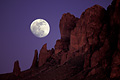
The Moon- 2: Genesis 37:1-11


Like David, Joseph was a shepherd, a dreamer, and probably a poet. He must’ve known his brothers hated him, so why continue to stir them up by telling them about his dreams? Either he was thick, a stirrer, or he had a deep trust in God that his dreams were from God and intended to be told. Perhaps he really believed the dreams and that they would come true, so whether his family liked it or not, Joseph would actually rule over them one day.

Dreamers, poets, adventurers, and kings….

Jacob must’ve sensed God in there somewhere because verse 11 says, ‘…he observed the saying’. Two shepherd boys, David and Joseph, believed in God, spoke confidently in the name of God, were tested severely by God, and rose to become extremely powerful people blessed by God, and who in turn, were a blessing to his people.

The imagery Joseph uses is, like David’s, that of creation: wheat sheaves, sun, moon, and stars. God used dreams as recorded in the Bible to speak to his people. There is no dualism between God’s Spirit and his creation, however marred by sin creation might be. Creation theology is so important. Is that why I love being amongst creation? Is that where I am truly closest to who I am meant to be?

The sun, moon, and stars bowed down to Joseph. David said we were crowned a little lower that the angels, and that all creation is subject to our dominion. O that we would take care of it all properly!

These readings have got my mind going because of the creation/dreaming aspects. The Australian Aboriginal creation stories came from the ‘Dreamtime’. Did God dream creation before he spoke it? How connected are some of our dreams to God, and should we speak them, thus doing our part in the creation/re-creation of the Kingdom of God?

Does God give us a glimpse of some of our future through the dreams we have? I suspect so!

Saturday, December 09, 2006

the sign of the sabbath

the rest of the seventh day is a memorial of creation, but also a sign of the covenant between god's people and himself. if a king were to ratify a treaty or agreement this would bear a sign, usually an image of the gods he owed allegiance to, but israel was commanded to not make any such image - instead the sabbath itself would be the sign, and a representation of his nature. only israel had a seven-day cycle of weeks.
we do not sense today how unique israel truly was, for the seven-day week has since become the practice of the world.


adapted from Jewish Roots, as printed in the Northumbria Community's Celtic Daily Prayer

Friday, December 08, 2006

hollow ponds today


zoe took this photo this morning while i was at whipps cross hospital at my physio appointment. you can see some more of her photos by clicking on the flickr link in the sidebar.

hollow ponds is a delightful bit of natural woodland just across the road from the hospital.

lovely init....?

Thursday, December 07, 2006

The Moon 1: Psalm 8


As I read this psalm, I’m aware again that I bring my preconceptions to what I think its about, yet again.

But I’m trying to imagine David writing it. He wasn’t a mathematician, scientist, scientist, or scholar, but a poet and artist, a musician who developed his gifts as a simple shepherd boy out in the hills. In looking at this psalm, I found the juxtaposition of his imagery interesting:
∑ God’s name, earth, glory, heavens
∑ Strength from babies to still enemies and avengers
∑ God’s fingers made the moon, stars, and heavens
∑ Human beings seem so small in comparison
∑ But we’re only a little lower than the angels
∑ Crowned with glory and honour
∑ We’ve been given dominion over all the earth
∑ And God’s name is excellent in all the earth

Heaven, earth, humans, and all creation, while different are inextricably connected, primarily because their source is God.

But I wonder why David put in the bit about babies having God’s strength to still enemies and avengers? It’s right in the middle of two verses about the glory of the heavens. Perhaps it’s the shepherd in the poet that has a firm grip on the reality of earthly life, while also seeing beyond it to the glory and majesty of God as revealed in ‘the cry of a tiny babe’ (Bruce Cockburn).

Heaven and earth; and God is in both places simultaneously inspiring the poet to consider God’s glory in both.

Tuesday, December 05, 2006

The Sun - 2: Mark 1:32-35


Why did they bring the diseased and possessed at night, after the sun had set? That thought occurred to me because I have this idea that night-time would have been a pretty scary time to be performing exorcisms. And I imagine people would have been pretty superstitious about such things back then. Well, some folks probably still are today!

Or was it simply that by the time Jesus had healed Simon’s mother the day was getting on anyway, and it just worked out that by the time everyone had heard about the healing and got around to her house with their own people in need of some form of healing, that it was night-time?

And Jesus, the great, divine physician, worked on into the night.

I wonder how much energy that took out of him. I wonder how much joy he got from seeing peoples’ lives changed as they were healed. I wonder if he was actually energised by his interaction with people in that way.

I know how drained I can become by being with people and giving out all the time. I need retreat times to re-energise. But there are other people who are the exact opposite of me, and who find energy when they’re interacting with others.

So Jesus worked on into the night.

Then, a long while before sunrise, he got up and went to a solitary place to pray. Jesus wasn’t scared of the dark.

I wonder if the moon was up that night, or if it was a starlit night. I imagine that if it was a cloudy, moonless night the disciples would have had difficulty finding him (verses 36, 37).

The creation of day and night, heavens and earth and the lights were all good and reflected the nature and purposes of God. Jesus would have appreciated and understood that better than anyone else. What is there to fear?

He may well have needed that prayer time to re-energise after a long and tiring day, full of healings and exorcisms. But he didn’t need to re-energise by the sun (as many pagans do). His power came from the Creator of the sun. His power came from God, who is not restricted to either day or night.

We must remember to worship the Creator, not the creation.

Monday, December 04, 2006

Inspiration for the Week

Antarctica Time lapse: A Year on Ice


i'd love to spend a year in antarctica.
what a beautiful place to contemplate the wonders of creation....

Thursday, November 30, 2006

The Sun - 1: Genesis 1:14-19


Don’t you think it interesting how we read what we want to, and project onto our readings our preconceptions of what we already think the reading is about?

Genesis 1:14 talks about the lights in the firmament being for ‘signs, and for seasons, and for days, and for years’. My initial thoughts were around the ‘signs’. What could these signs be? The moon turning to red at the end of the age, perhaps? And the seasons; how does the sun tell us about the seasons? It comes up and goes down every day regardless of the time of year. Although, depending on your position on the globe, the arc of the sun will vary according to the season.

But verse 14 hadn’t even mentioned the ‘the sun’ yet – only, ‘lights in the firmament’. I had already projected onto the scripture my own preconceptions of what I thought it was talking about. The lights would have to include the stars, sun, and moon. The stars have always been connected with the thought and practice of interpreting signs, and the different constellations do change according to the seasons.

Its not until verse 16 that the scripture reveals something of the nature of those lights: greater light to rule the day; lesser light to rule the night; and the stars. They weren’t even called ‘sun’ and ‘moon’ then. Probably to keep to the point that it was God who created them, therefore, it is God who is to be worshipped, not the greater and lesser lights (many pagans were at that time worshipping sun and moon, which they saw as deities – some still do).

But my initial thought was around projecting my preconceptions onto the scripture: I already know what this is about! But maybe I don’t, really….

God’s creation had a purpose, and the purpose and creation were good.

I wonder what else I miss seeing and understanding because I think I already know what its about? The creation reflects the nature and purposes of God, which are quintessentially good. So, why do we continually seek to stuff everything up?

How should we be interpreting the lights for signs, seasons, days, and years in the context of them reflecting that nature and purposes of our good and gracious God?

Friday, November 17, 2006

Beautiful Creation: Psalm 65:9-13


This reading gives such a wonderful sense of God’s care and generosity for the earth, and for us who live on it and with it. Because of his care and generosity, there is a palpable abundance and health of growth along with an uncontainable joy expressed in response – the joy of knowing and feeling and experiencing his care.

“The river of God is full of water; you provide their grain”. There’s nothing stingy about God at all.

I remember watching the sun come up one morning while on retreat. It looked as though it was coming up out of the sea itself. It was a deep reddy/orange colour that illuminated the sky above it, and caused the sea to shimmer in front. A most beautiful sight to watch first thing in the morning.

How many times has it done that? How many times has it been seen? How many times has God been thanked for his Generosity in feeding the world with the sun and the rain? And how many times have people worshipped the creation rather than the Creator?

But still it pleases him to care for us.

Thank you Father…..

Wednesday, November 08, 2006

And there was light! Genesis 1:1-5


I was imagining a real sense of drama as I read this. The drama of the darkness and moody feeling of nothingness as the earth was without form and void – with the Spirit of God moving around as though, perhaps, he’s searching for something.

And then, “Bang”, God says, “Let there be light!”, And there was !!

What that must have looked like when he did that, and there was light for the first time….

I have this dramatic image of an enormous lightning strike that pierced the darkness with forks spreading across the sky until it was all lit up. Or was it just like turning on a light switch and the darkness was instantly replaced by light?

We naturally associate the light with the sun, but he didn’t create the sun until the fourth day (verses 14-19), so was the initial burst of light simply an incredible burst of pure energy?

It’s interesting how questions raise themselves when you give yourself time to read and ponder. Usually, when preparing a sermon, there is the pressure of time to get it done by. That pressure can have the detrimental effect of causing me to skim lightly over the text and look only for the obvious things. On the other hand, time pressures can also have the positive effects of focussing the mind and being kept from distraction.

But is seems to me that there needs to be the spiritual discipline of producing the space to allow ourselves to consume God’s word, and like his Spirit, be ‘moving over the waters’ (of our souls).

If I give myself, and God, the space to move over my soul, then perhaps he will be searching me. And then, who knows? Bang! He may even create something new in me! Some light may be born in my soul where before, there was only darkness. And the light will be good, and a new day will dawn in my life…the first day of the rest of my life (so to speak).

Thursday, November 02, 2006

life - a journey through time


just discovered this stunningly good site, through stumblupon.

its a great slideshow of images that give frans lanting's idea of the evolution of our world. the photos are fantastic, and there's a gentle blend of music tracks running behind the slideshow. it also has a written commentary of lanting's evolutionary thoughts, and the option to stop the show, click on an image and learn more about where he got it.

the philosophy is purely evolutionary, and the christian will want to bring some critique to it, but nevertheless, you can't help but admire the sheer beauty of our planet home, its diversity, complexity, power and fragility. and the skill of the photographer/artist in bringing the beauty to our attention.

this kind of thing always brings to my mind the psalmist's wonder when he says in psalm 24:1, 'the earth is the lord's, and everything in it.' i wish we would take better care of the generous gift of god to us, and this website helps us to appreciate what we've been given.

following the release of the stern report this week on the economic affects of global warming, and the new level of debate that is happening world-wide about the future of our planet home, why not take 20 mins to sit and contemplate with this slideshow about how you may or may not value god's great gift to us, and what your lifestyle means to our common future?